Deep Residual Learning for Image Recognition
Official Best Paper · SourceShortcut connections let a network learn changes relative to its input, helping optimize deeper networks.

TOP CONFERENCE PAPERS
Explore sourced AI research by conference, year, and recognition. Official awards include evidence; EyeCode Pick is a separate editorial selection.
CONFERENCE DIRECTORY
PAPER LIBRARY
Shortcut connections let a network learn changes relative to its input, helping optimize deeper networks.
The Transformer uses attention to model sequences without recurrent or convolutional networks.
Separates fast motion estimation from slower mapping to process LiDAR measurements in real time.
Studies counting hard-to-distinguish objects in underwater scenes and introduces the IOCfish5K dataset.
Studies how compactly Transformers represent formal languages. The proofs compare their representation size with automata and temporal logic, while exposing the computational difficulty of model verification.
Examines failures when instructions arrive over multiple conversation turns. Simulated conversations separate task aptitude from reliability and trace how premature assumptions affect later responses.
Computes the matrix polar decomposition used by Muon. Minimax-designed polynomial iterations use GPU-friendly matrix multiplications, with analysis of approximation error and finite-precision behavior.
Investigates safety alignment concentrated in the first output tokens. Case studies and regularized fine-tuning objectives explore deeper alignment and its persistence under subsequent fine-tuning.
Decomposes prediction changes during language-model fine-tuning. The framework connects interactions between responses with repetition, hallucination, and decreasing preferred-response probability during prolonged DPO training.
Updates language-model knowledge while limiting interference with retained facts. Parameter changes are projected into a null space associated with preserved knowledge, supported by analysis and sequential-editing experiments.
Attributes training data contributions to a particular model run. It accumulates Shapley values of gradient updates rather than repeatedly retraining models on different data subsets.
Extends promptable segmentation from images to video. A Transformer with streaming memory works with an interactive data engine to maintain prompted object masks across frames.
Combines model cascades with speculative decoding. Deferral rules are implemented through speculative execution and parallel verification to study inference cost–quality trade-offs.
Introduces Infinity-Chat to study diversity in open-ended responses. The analysis examines repetition within models, similarity across models, and differences in human preferences that automated judges may miss.
Studies gating in softmax attention. Head-specific sigmoid gates after scaled dot-product attention provide a controlled way to examine nonlinearity, sparsity, training stability, and attention sinks.
Studies network depth in self-supervised goal-conditioned reinforcement learning. Locomotion and manipulation experiments examine how deep residual architectures and training scale affect goal-reaching behavior.
Separates the onset of useful diffusion generation from later training-data memorization. Experiments and a random-features model analyze how training dynamics create a window of generalization before memorization.
Compares base models and models trained with verifiable rewards on reasoning tasks. Pass@k and solution-distribution analyses distinguish improved sampling efficiency from the emergence of new reasoning patterns.
Studies the value of seeing an unlabeled input sequence before online prediction. Matching bounds relate mistakes to Littlestone dimension and clarify the gap between transductive and standard online learning.
Uses a toy model of overlapping features to investigate scaling laws. Geometric analysis and language-model measurements connect representation dimension, superposition strength, and prediction loss.
Models image generation as predicting the next resolution scale. Coarse-to-fine generation replaces raster-order token prediction and supports studies of scaling and image editing.
Addresses the cost of high-order differential operators in neural networks. Taylor-mode automatic differentiation and randomized tensor contractions estimate operators for applications such as physics-informed neural networks.
Questions whether every pretraining token deserves equal weight. Selective Language Modeling scores tokens with a reference model and focuses training loss on tokens aligned with the target distribution.
Studies control of image quality separately from diversity. Autoguidance steers diffusion sampling using a smaller or less-trained version of the same model rather than an unconditional model.
Connects participant demographics and stated preferences with feedback on language-model conversations. The dataset enables analysis of representation, cultural variation, and disagreement in alignment data.
Revisits conformal prediction from a Bayesian perspective on deployment risk. Bayesian quadrature represents plausible test-loss distributions beyond the information conveyed by frequentist guarantees alone.
Builds minimal algorithmic tasks for testing planning and diverse generation. Comparisons of next-token learning, multi-token methods, and input noise provide a controlled testbed for creative behavior.
Trains models for collaboration across conversation turns rather than only the next response. Simulated interactions estimate longer-term rewards for clarifying user intent and supporting task completion.
Extends score matching to observations missing arbitrary subsets of coordinates. Importance-weighted and variational estimators enable distribution learning without fully observed data.
Analyzes the trade-off between difficult training-time infilling and flexible inference-time token order in masked diffusion. Theory and experiments show how adaptive decoding can avoid difficult subproblems.
Studies prediction in policies prioritizing the worst-off. Mathematical models and a long-term unemployment case study compare better predictions with expanding administrative capacity to provide assistance.
Tests whether arbitrary token order helps reasoning in diffusion language models. JustGRPO uses left-to-right RL rollouts to investigate avoidance of uncertain decisions while retaining parallel inference decoding.
Develops sampling algorithms using score or gradient queries for diffusion and log-concave distributions. Complexity analysis connects target accuracy with score error and assumptions about the data distribution.
Examines coding models trained against deception detectors. A taxonomy distinguishes representation drift from detector-evading output strategies, with analysis of KL regularization and detector penalties.
Investigates which training clips influence generated motion. Gradient-based attribution uses motion-weighted masks to separate temporal dynamics from static appearance and guide fine-tuning data selection.
Separates memorization of particular data from generalization about its generating process. An information-based measure and capacity experiments study data size, memorization, and membership inference.
Investigates why diffusion models trained on separate data splits can generate similar outputs from the same noise. Random-matrix analysis isolates shared Gaussian statistics and finite-data variability as a baseline for nonlinear models.
Proves delayed generalization in ridge regression. Analysis of gradient descent with weight decay connects the delay to training hyperparameters and examines how tuning can amplify or remove grokking.
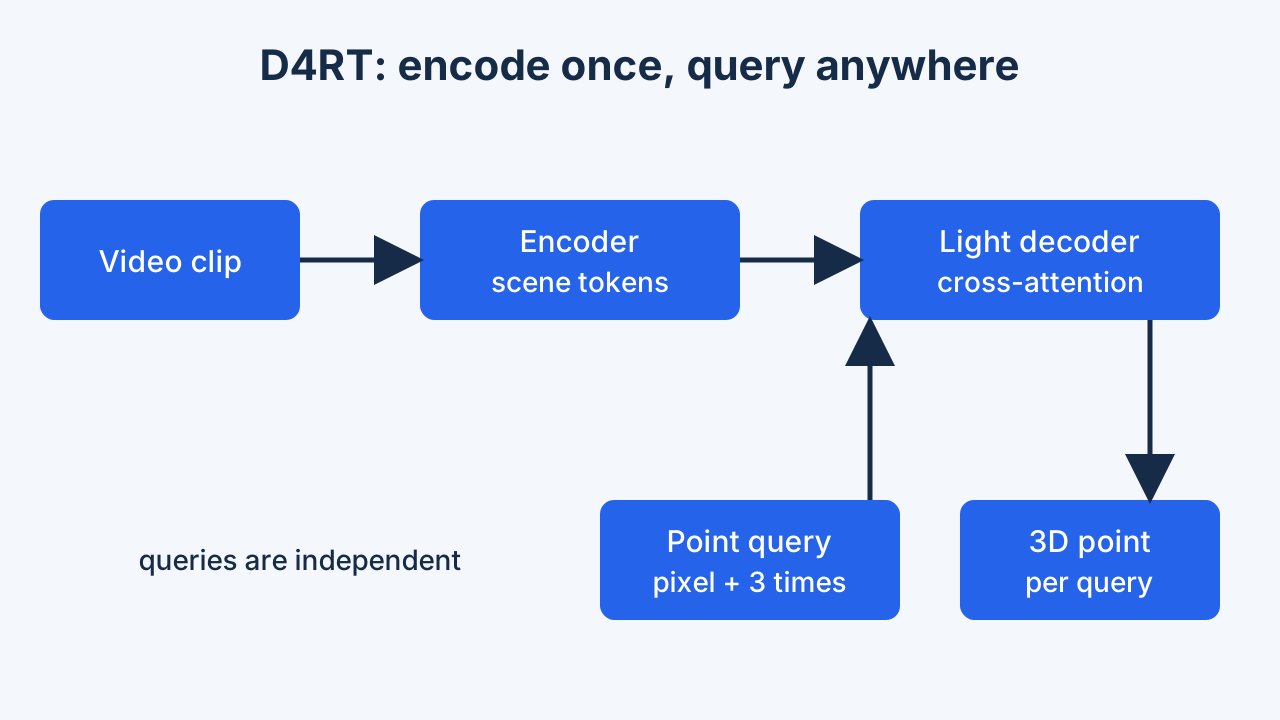
Combines depth, spatiotemporal correspondence, and camera estimation from dynamic video. A unified point-query interface replaces separate task decoders in a feed-forward approach to 4D scene reconstruction.
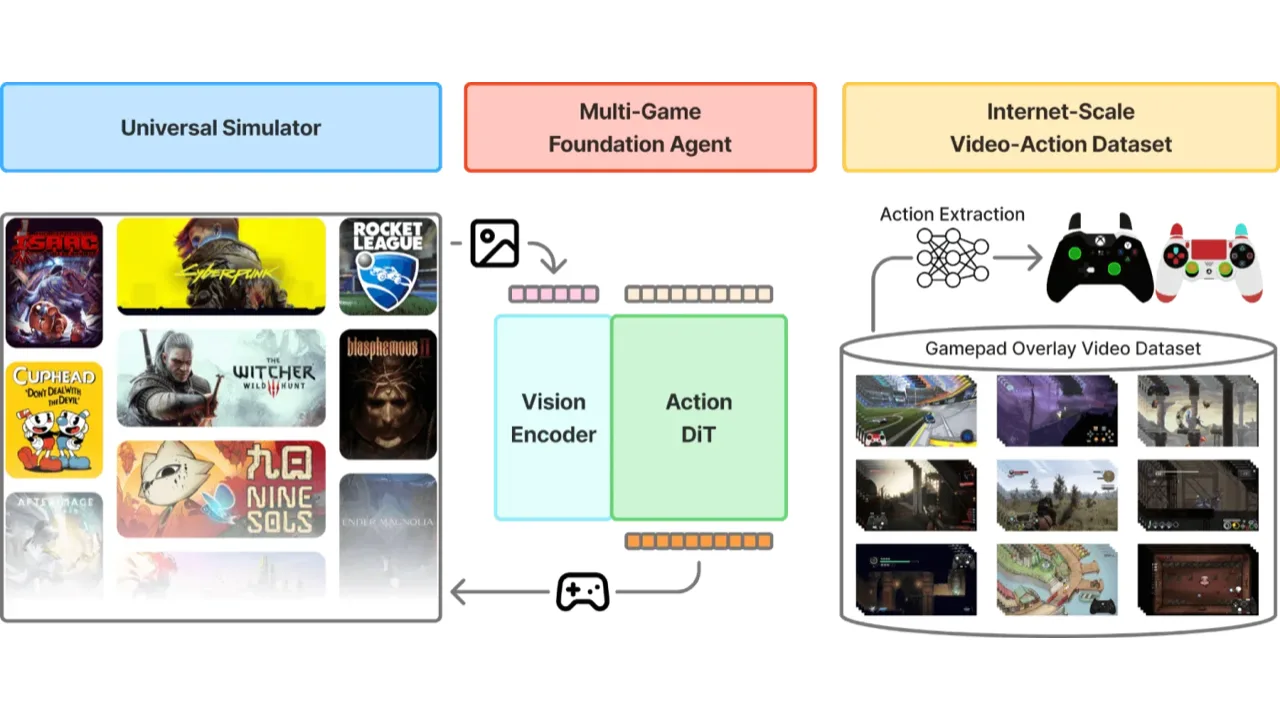
Studies vision–action agents across games. Actions extracted from gameplay video support behavior cloning and a multi-game evaluation environment for examining transfer to unseen games.
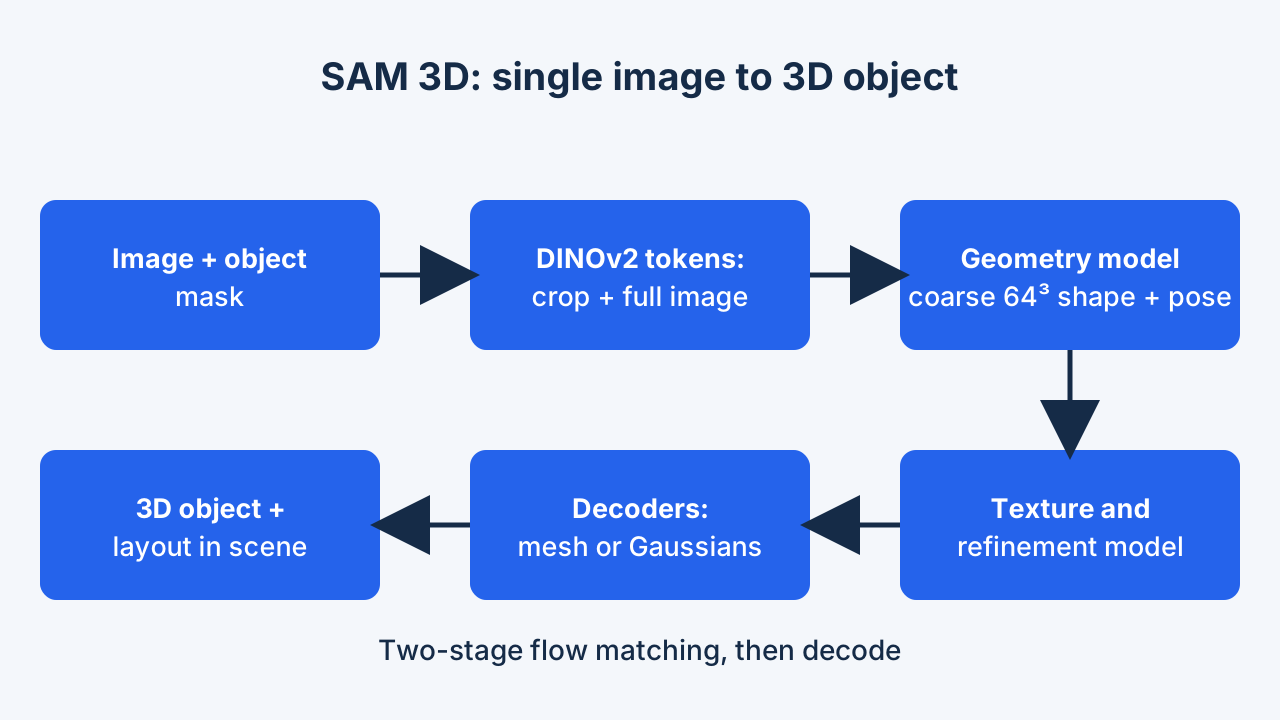
Reconstructs object geometry, texture, and layout from a single image. Human- and model-assisted annotation combines synthetic pretraining with real-image alignment for cluttered and occluded scenes.
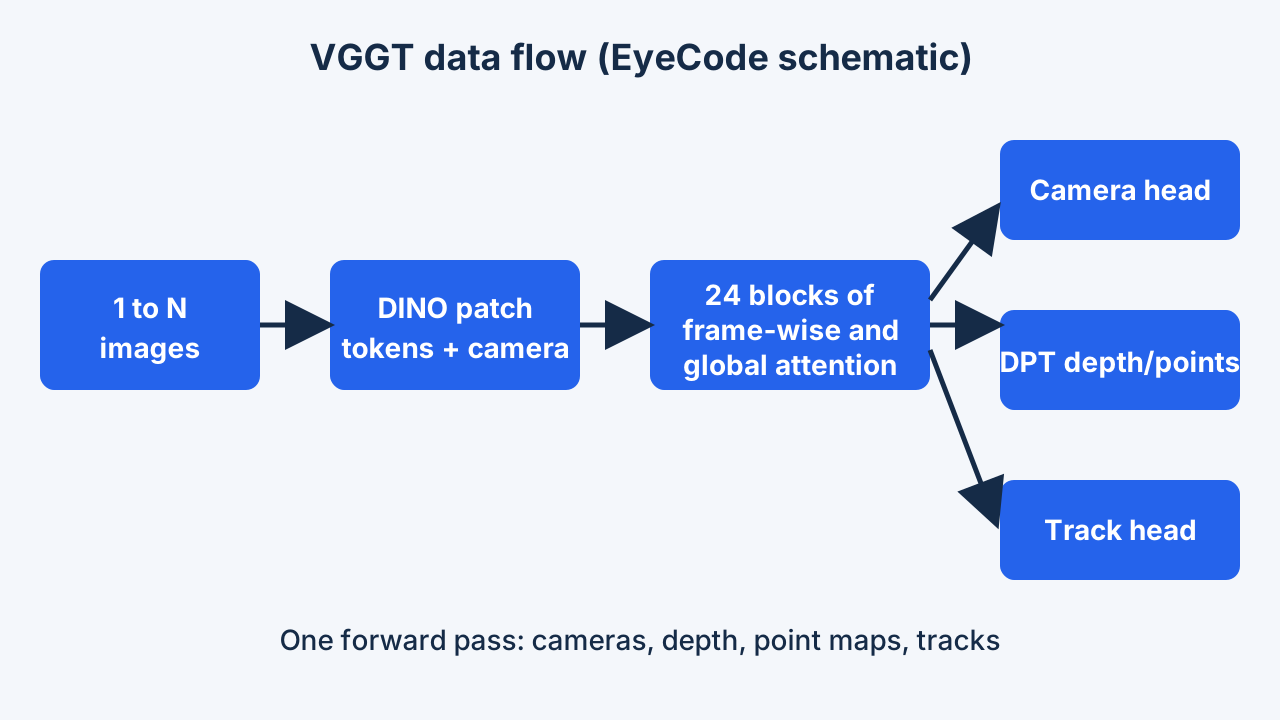
Uses one feed-forward network to infer cameras, depth, point maps, and tracks from one or many images. The shared architecture studies jointly learned 3D geometry instead of separate task-specific solvers.
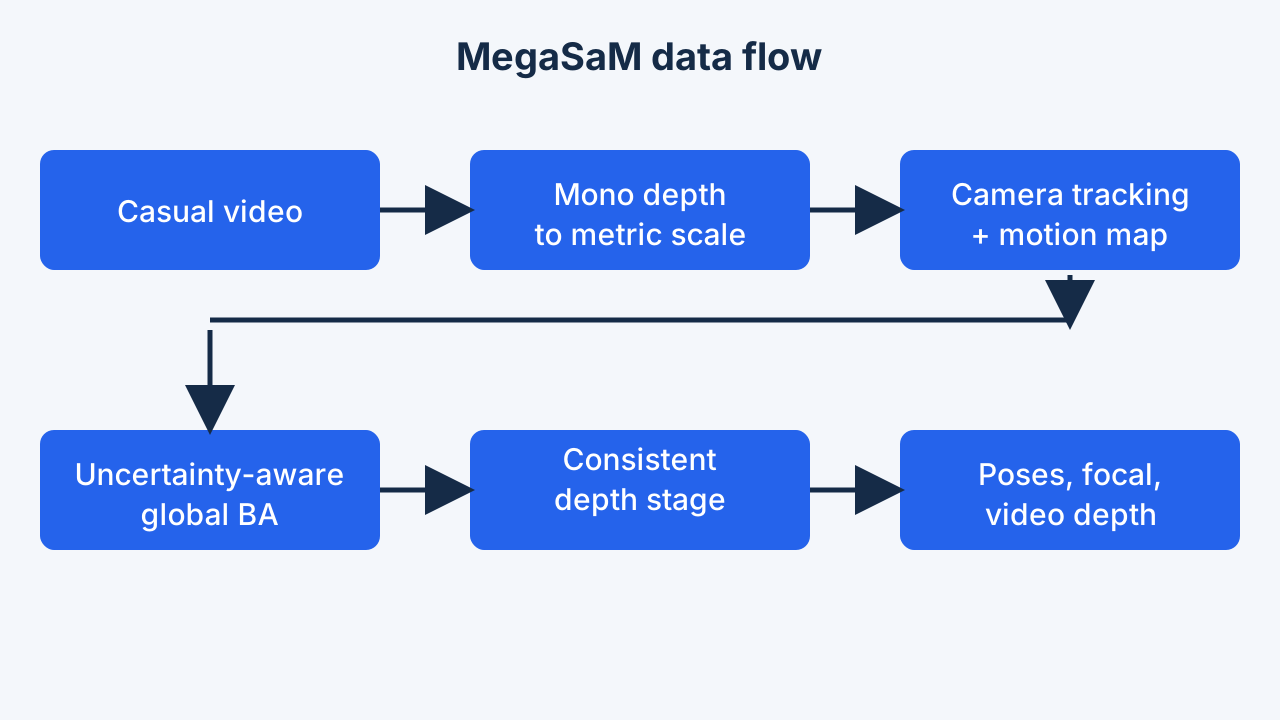
Estimates cameras and depth from casual monocular videos with dynamic scenes and unconstrained camera motion. Training and inference changes to deep visual SLAM address violations of static-scene assumptions.
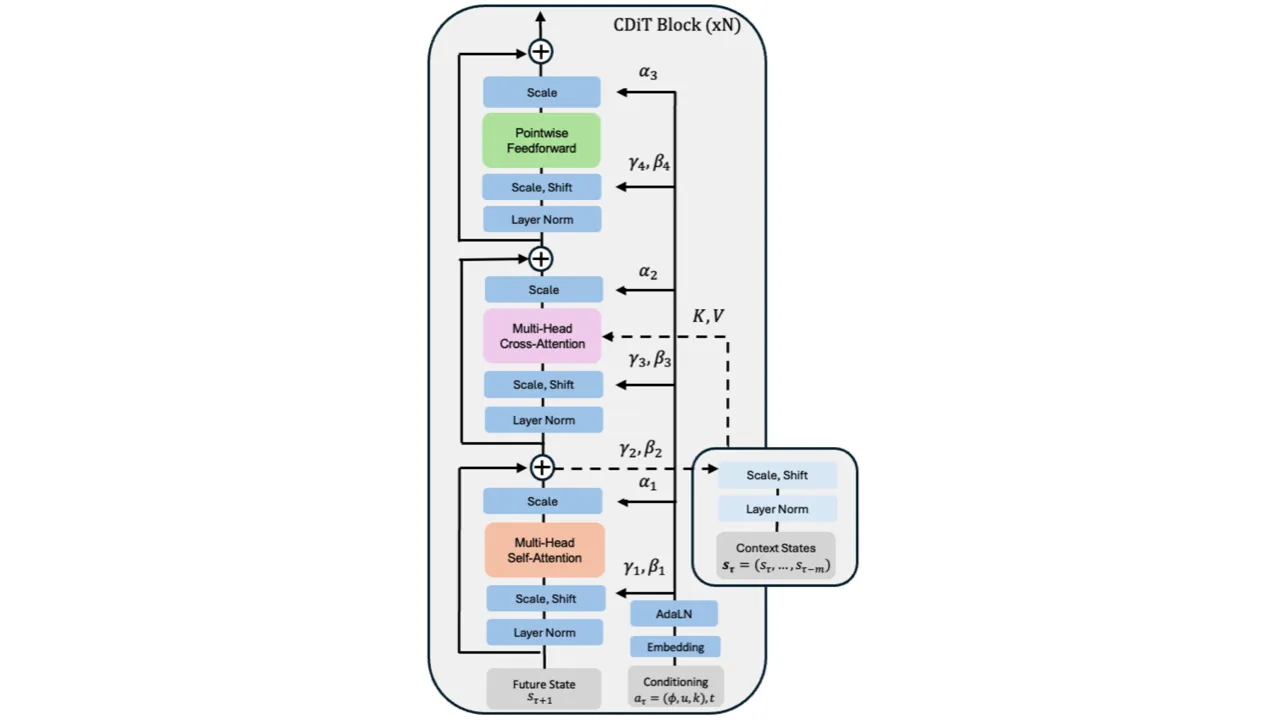
Predicts future visual observations from history and navigation actions. A conditional diffusion Transformer simulates and evaluates trajectories, allowing planning constraints beyond a fixed navigation policy.
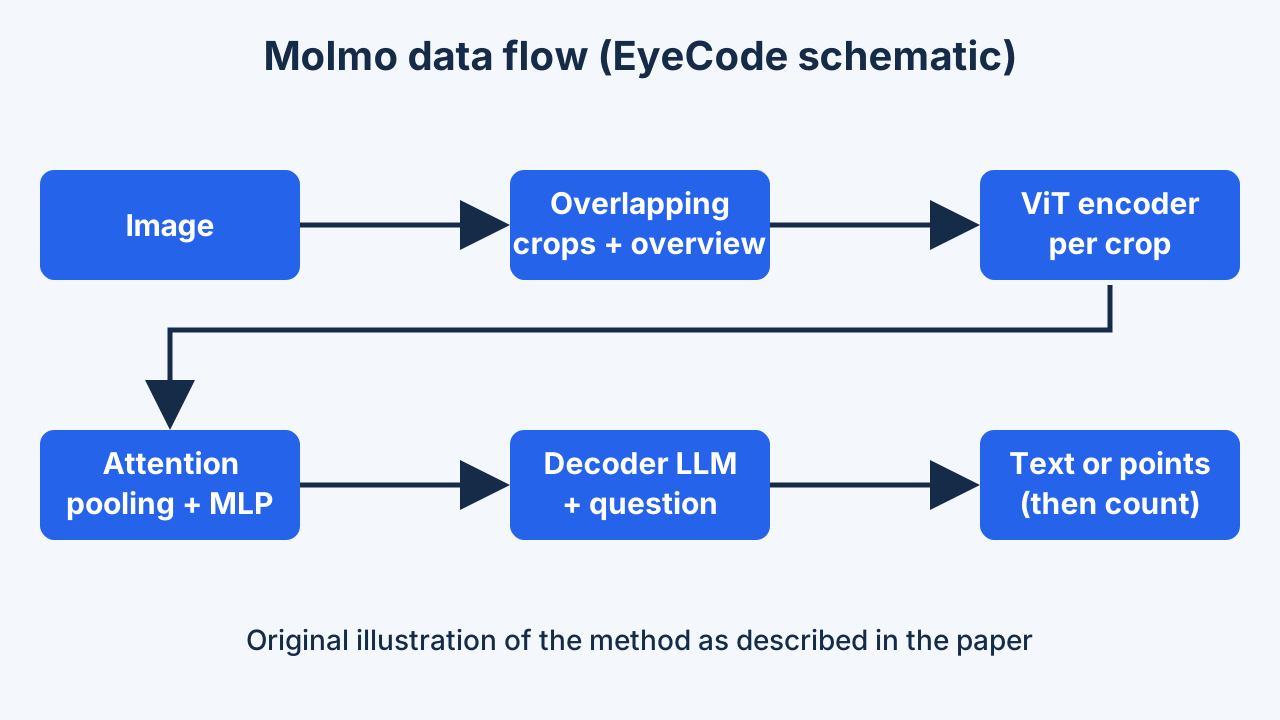
Studies open-data, open-weight vision–language models. Human-collected captions, question answering, and pointing data provide a basis for examining model choices and training pipelines without distilling proprietary VLM outputs.
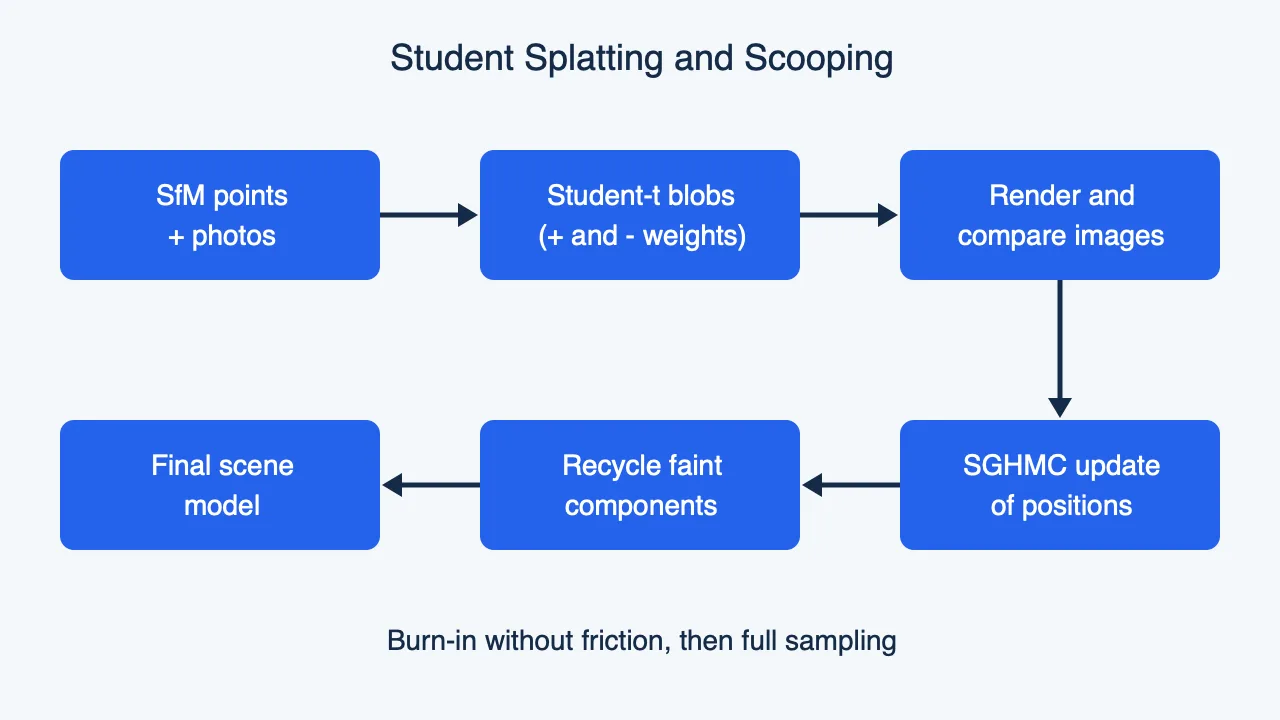
Revisits mixture representations in 3D Gaussian Splatting. Student distributions with positive and negative densities, together with a sampling-based optimizer, explore scene representations beyond conventional Gaussian components.
Generates interlocking brick structures from text. An autoregressive model uses validity checks and physics-aware rollback to constrain designs for stability and assembly.
Studies spatially selective focusing at different image locations. A Lohmann lens and phase-only spatial light modulator combine with contrast and disparity cues to iteratively adjust the focus map.
Learns 3D scene reconstruction from images without known cameras or 3D supervision. Disentangled camera and scene representations use ray structure and view reconstruction to learn from 2D images.
Reconstructs changing light intensity from photon timestamps without source synchronization. Flux-estimation theory and a Fourier-domain algorithm analyze scene motion and illumination over widely different timescales.
Adds spatial conditioning to pretrained text-to-image diffusion models. A control branch with zero-initialized convolutions accepts edges, depth, or poses while preserving the original backbone.
Defines promptable image segmentation. A model, interactive data engine, and large mask dataset provide a foundation for segmentation across new images and tasks.
Designs task-specific cameras with freeform pixel shapes. Modeling hardware as a network’s first layer learns optical masks for low-measurement sensing with limited identifying visual detail.
Examines limitations of concept inhibition in text-to-image diffusion. Analysis of compositional inference shows why combining concepts matters when evaluating model safety mechanisms.
Addresses gradients at visibility discontinuities in differentiable rasterization. Micro-edges approximate the continuous process behind discrete pixels, enabling geometry optimization without altering the forward rendering.
Represents textures directly on triangle meshes with anisotropic heat kernels. Surface-aware optimization and density control replace UV unwrapping when fitting existing textures or multi-view images.
Scales context windows for object-centric 3D reconstruction using sparse attention. Coarse-to-fine prediction, geometry-aware routing, and sequence parallelism focus computation on informative regions for geometry and appearance recovery.
Refines surface normals from frozen RGB backbones using polarization measurements. Input/output offsets and reflectance decomposition are optimized through differentiable rendering to add physical constraints at inference time.
Retargets human motion to humanoids while preserving body–object–terrain relationships. An interaction mesh and kinematic constraints generate and augment motion data for loco-manipulation.
Derives Gaussian marginalization and conditioning on general linear manifolds. Linearization extends the method to smooth manifolds, with covariance-estimation applications in SLAM and constrained optimization.
Introduces metric-aware uncertainty to stereo visual odometry. Learned covariance guides keypoint selection and residual weighting, connecting image-matching reliability with pose-graph optimization.
Maintains object identity and history across revisits to changing environments. Volatility-aware updates to Live, Delta, and Meta memories support temporal scene queries from aligned multi-session observations.
Studies selective control of skeletal-muscle actuators in biosyncretic robots. Optimized thin-film interdigitated electrodes target different muscle regions to support coordinated actuation.
Learns a unified position-and-force policy for legged robots. Simulated reinforcement learning uses state history to estimate forces and compensate motion, supporting contact-rich manipulation without force sensors.
Combines hierarchical planning and learned control for dual-arm assembly. Assembly sequences, grasps, and motion plans connect with local contact policies across multi-part object geometries.
Learns indoor navigation from RGB using large-scale simulated reinforcement learning. A vision encoder and causal Transformer combine perception with history for studying transfer to real robots.
Controls vehicles near handling limits using conditional diffusion. A physics-informed dynamics-parameter distribution is conditioned on online measurements and integrated into model predictive control.
Studies stable off-policy learning for high-dimensional robot control. Bounds on weight, feature, and gradient norms combine with parallel simulation and replay to limit critic-error amplification.
Personalizes robotic mealtime assistance in homes. Modular hardware, multiple interaction methods, and parameterized behavior trees adapt feeding, drinking, and mouth-wiping to individual needs.
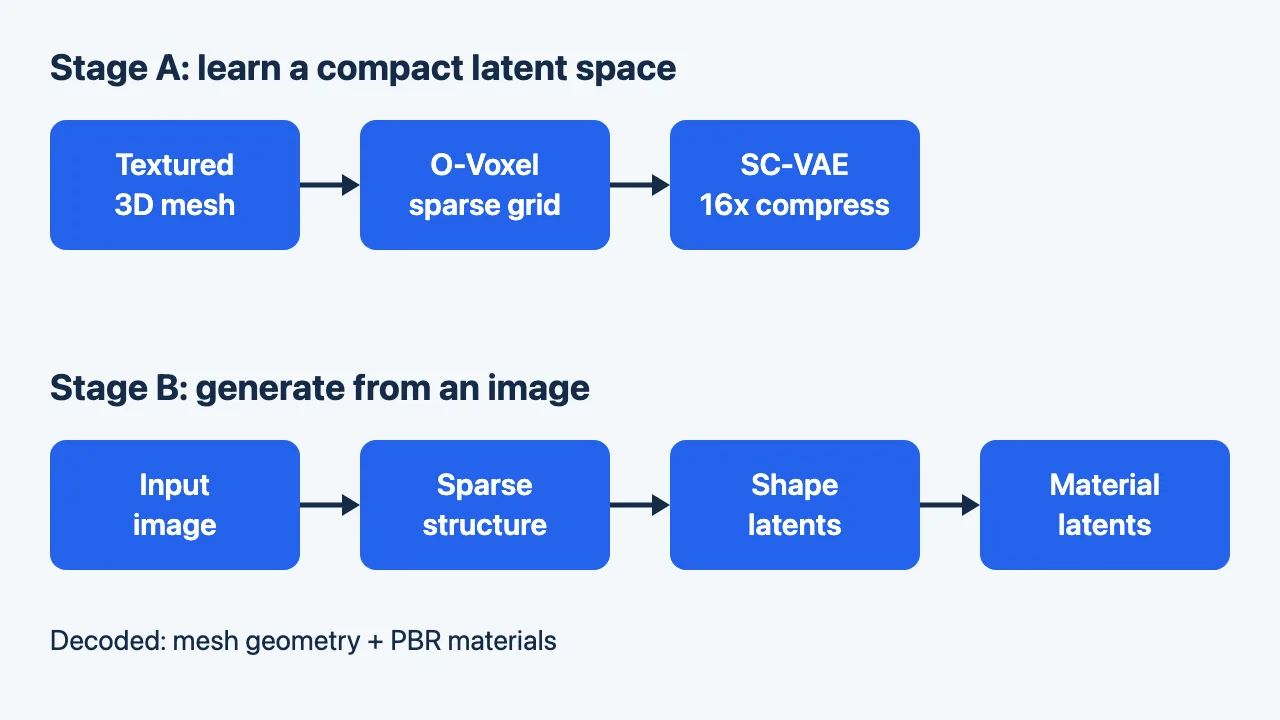
The paper proposes O-Voxel, a sparse voxel representation holding both geometry and PBR material, and an SC-VAE with 16x compression so a textured 1024 asset needs about 9.6K tokens. Flow-matching models totaling about 4B parameters generate shape and material from an image, and the authors report gains over baselines in reconstruction and generation experiments.
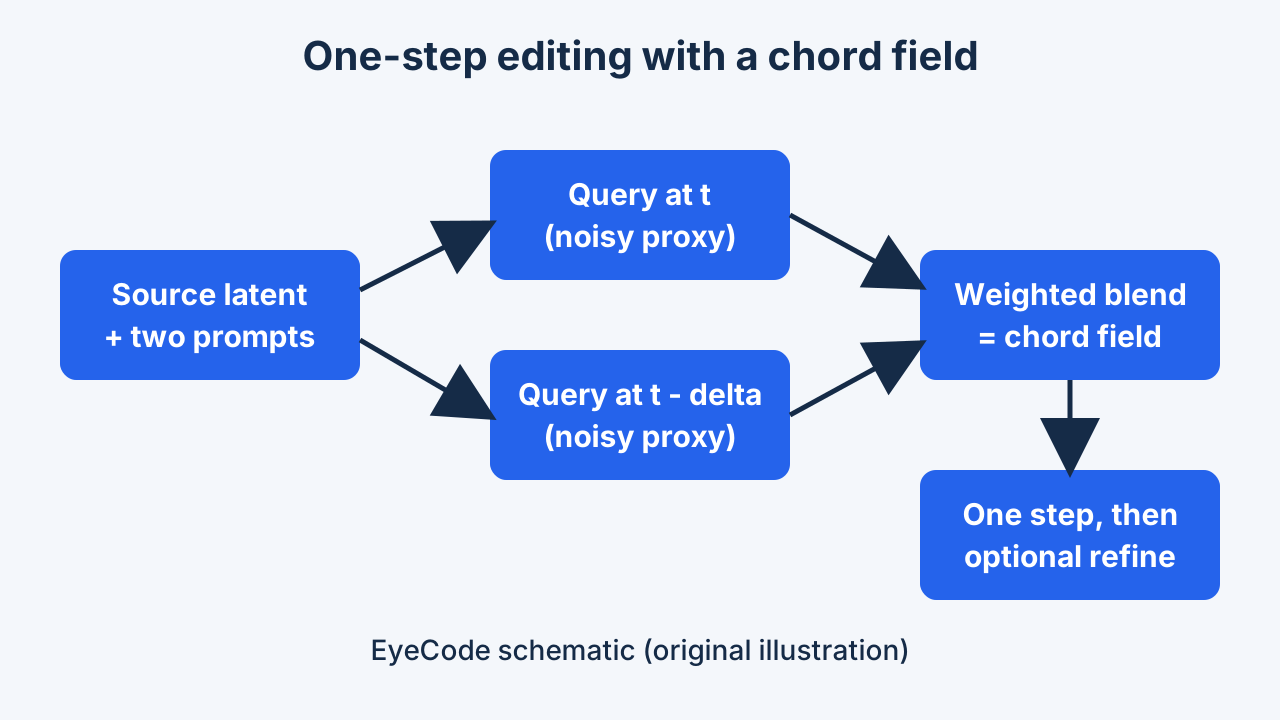
ChordEdit performs text-guided image editing in a single step for one-step image generators, without training or inversion, using a low-energy control field derived from dynamic optimal transport. On PIE-bench the full version runs in 0.38 seconds.
No verified papers match these filters. Choose another conference, year, or selection.