Deep Residual Learning for Image Recognition
Official Best Paper · SourceShortcut connections let a network learn changes relative to its input, helping optimize deeper networks.

TOP CONFERENCE PAPERS
Explore sourced AI research by conference, year, and recognition. Official awards include evidence; EyeCode Pick is a separate editorial selection.
CONFERENCE DIRECTORY
PAPER LIBRARY
Shortcut connections let a network learn changes relative to its input, helping optimize deeper networks.
The Transformer uses attention to model sequences without recurrent or convolutional networks.
Separates fast motion estimation from slower mapping to process LiDAR measurements in real time.
Studies counting hard-to-distinguish objects in underwater scenes and introduces the IOCfish5K dataset.
Studies how compactly Transformers represent formal languages. The proofs compare their representation size with automata and temporal logic, while exposing the computational difficulty of model verification.
Examines failures when instructions arrive over multiple conversation turns. Simulated conversations separate task aptitude from reliability and trace how premature assumptions affect later responses.
Computes the matrix polar decomposition used by Muon. Minimax-designed polynomial iterations use GPU-friendly matrix multiplications, with analysis of approximation error and finite-precision behavior.
Investigates safety alignment concentrated in the first output tokens. Case studies and regularized fine-tuning objectives explore deeper alignment and its persistence under subsequent fine-tuning.
Attributes training data contributions to a particular model run. It accumulates Shapley values of gradient updates rather than repeatedly retraining models on different data subsets.
Extends promptable segmentation from images to video. A Transformer with streaming memory works with an interactive data engine to maintain prompted object masks across frames.
Studies network depth in self-supervised goal-conditioned reinforcement learning. Locomotion and manipulation experiments examine how deep residual architectures and training scale affect goal-reaching behavior.
Separates the onset of useful diffusion generation from later training-data memorization. Experiments and a random-features model analyze how training dynamics create a window of generalization before memorization.
Addresses the cost of high-order differential operators in neural networks. Taylor-mode automatic differentiation and randomized tensor contractions estimate operators for applications such as physics-informed neural networks.
Revisits conformal prediction from a Bayesian perspective on deployment risk. Bayesian quadrature represents plausible test-loss distributions beyond the information conveyed by frequentist guarantees alone.
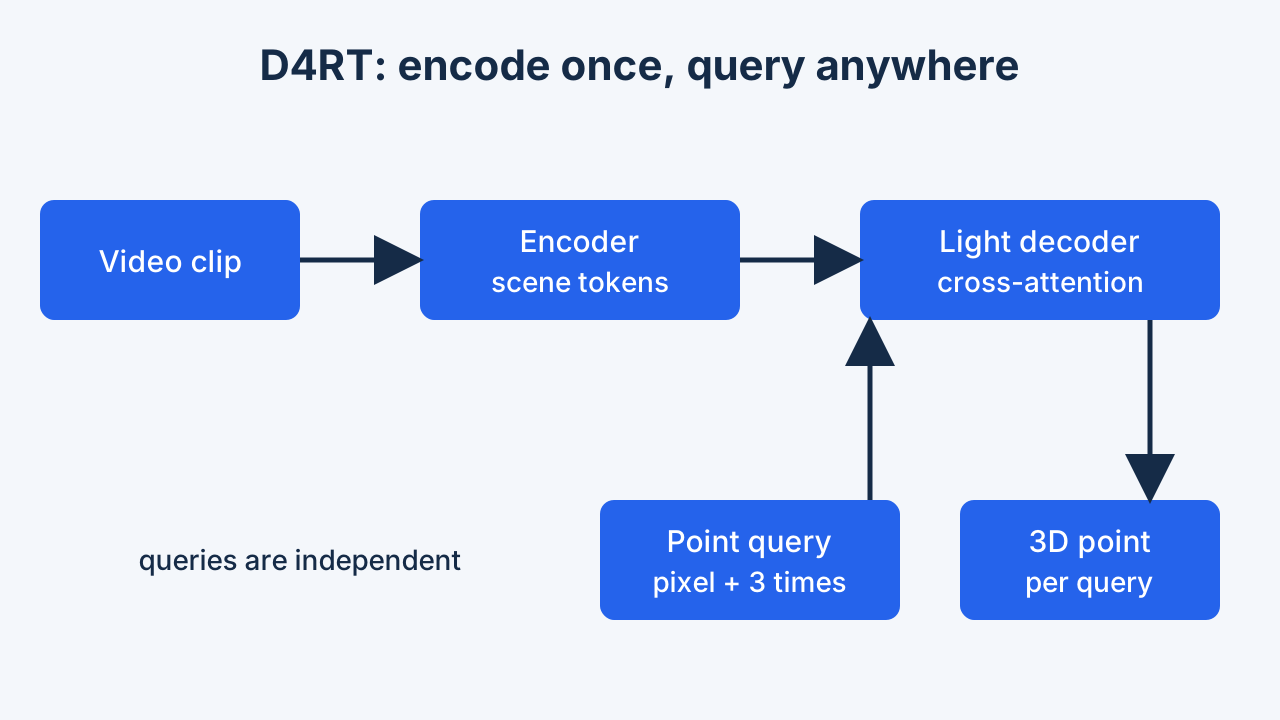
Combines depth, spatiotemporal correspondence, and camera estimation from dynamic video. A unified point-query interface replaces separate task decoders in a feed-forward approach to 4D scene reconstruction.
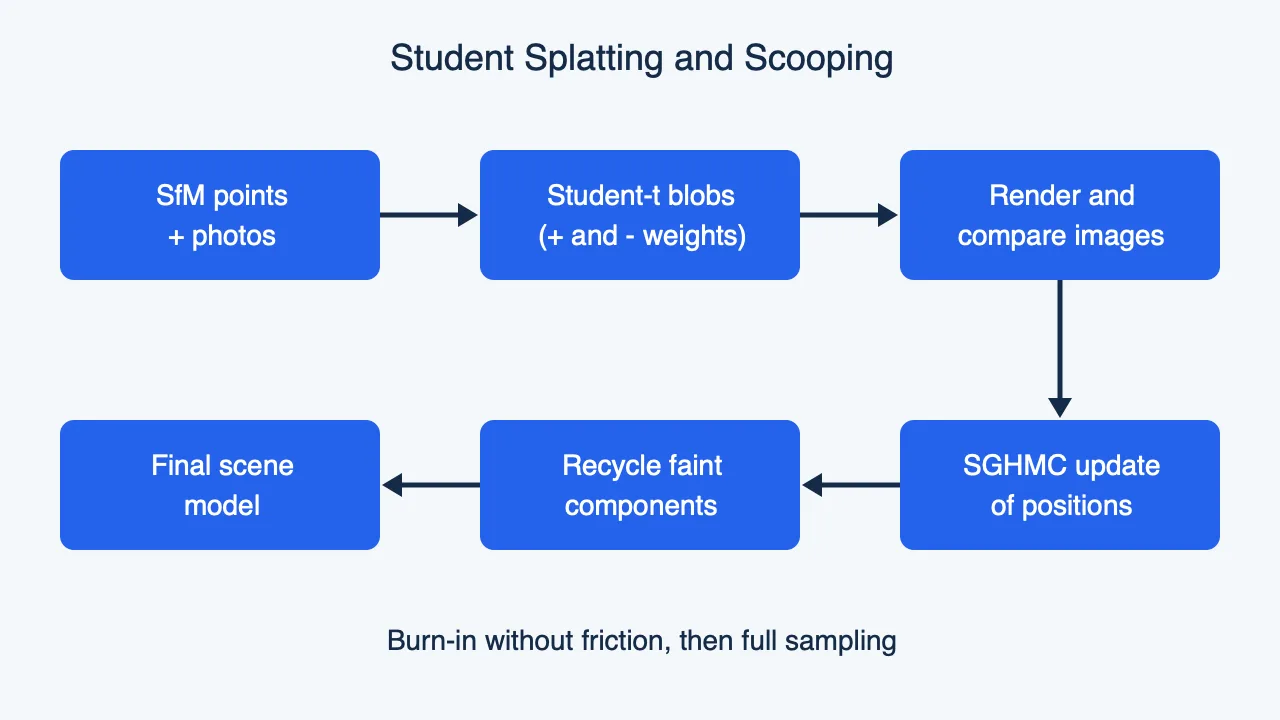
Revisits mixture representations in 3D Gaussian Splatting. Student distributions with positive and negative densities, together with a sampling-based optimizer, explore scene representations beyond conventional Gaussian components.
Studies spatially selective focusing at different image locations. A Lohmann lens and phase-only spatial light modulator combine with contrast and disparity cues to iteratively adjust the focus map.
Retargets human motion to humanoids while preserving body–object–terrain relationships. An interaction mesh and kinematic constraints generate and augment motion data for loco-manipulation.
Introduces metric-aware uncertainty to stereo visual odometry. Learned covariance guides keypoint selection and residual weighting, connecting image-matching reliability with pose-graph optimization.
Studies selective control of skeletal-muscle actuators in biosyncretic robots. Optimized thin-film interdigitated electrodes target different muscle regions to support coordinated actuation.
No verified papers match these filters. Choose another conference, year, or selection.